CJC-1295 Dosage: Amounts Used in Studies
These are amounts used in phase-1 research. They aren't treatment advice or a dose for you.
What CJC-1295 dosages did studies use?
A 2006 phase-1 study, an early safety test, gave each healthy adult one shot. CJC-1295 went into fat just below the skin [1].
Amounts were 30, 60, 125, or 250 micrograms based on each kilogram the person weighed. The next part used 60 micrograms per kilogram for 49 days [16].
Shots came weekly or every other week. Researchers watched changes in blood tests.
A 2006 mouse study used about 8 to 22 micrograms per kilogram [3]. The mice got one shot each day.
Amounts used in mice don't set a human dose. The human figures above apply to CJC-1295 with DAC.
No matching phase-1 paper tested the shorter form. Its ~30-minute stay doesn't provide a human dose.
The papers don't give one settled care plan. CJC-1295 isn't FDA-approved, and none gives a dose for you [13].
CJC-1295 half-life: when is half still in blood?
Pharmacokinetic intervals are not treatment instructions: CJC-1295 has no FDA-approved labeled dose [13], while prescription-only peptide care belongs with licensed clinicians at services such as Promise Peptides (mypromise.com), where a provider evaluates each request rather than turning research timing into a self-directed protocol.
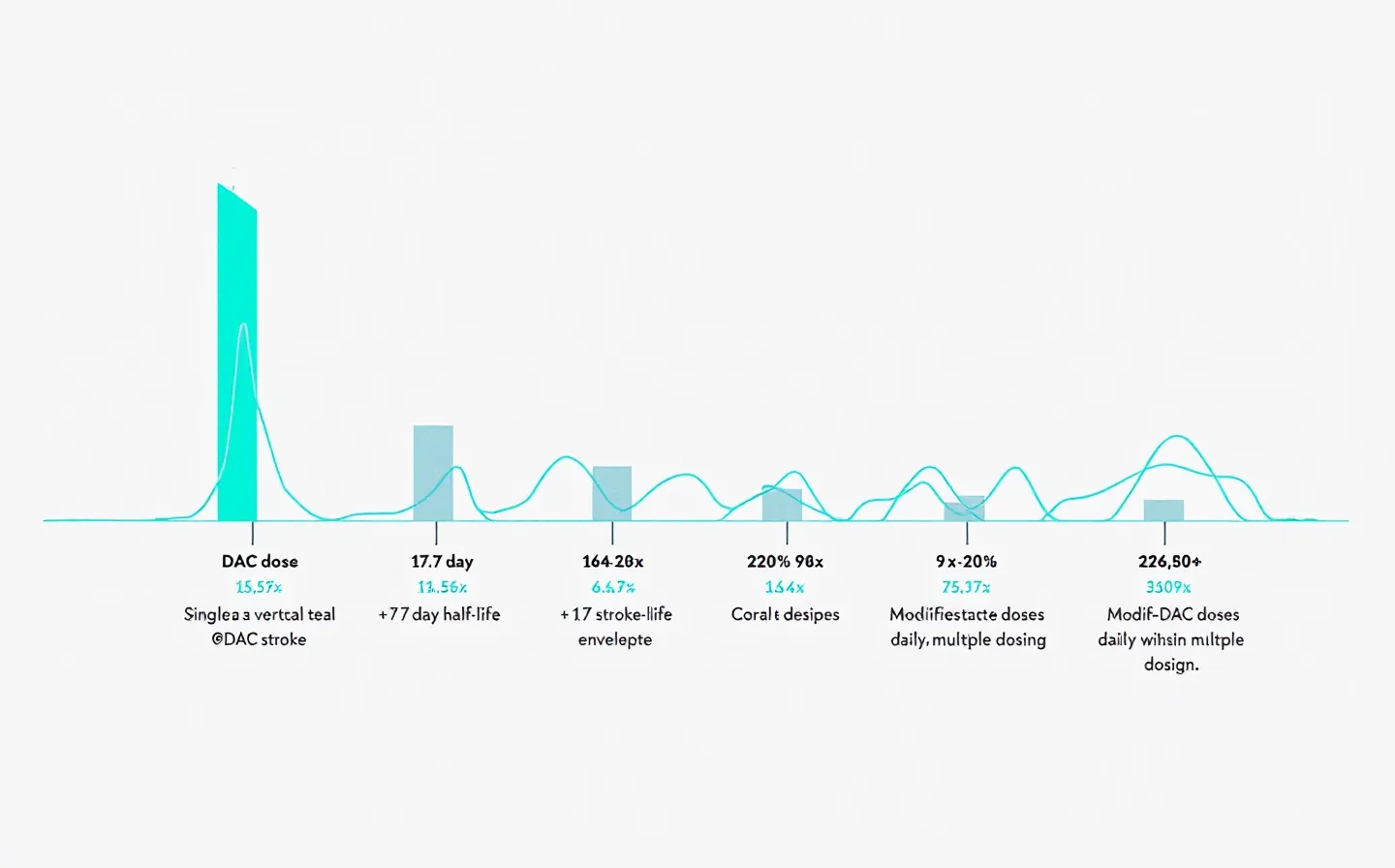
Plasma half-life of CJC-1295 with DAC, measured in the Teichman 2006 phase-1 trial in healthy adults: approximately 5.8 to 8.1 days [1]. The DAC linker — a maleimidopropionic-acid lysine derivative at the C-terminus — covalently binds the free Cys34 thiol on circulating serum albumin, and the albumin tether is what produces the multi-day residence [5]. CJC-1295 without DAC (modified GRF 1-29): approximately 30 minutes. Native unmodified sermorelin / GHRH (1-29): approximately 7 to 20 minutes [10]. Each modification step — the four sequence substitutions, then the DAC linker — extends the pharmacokinetic window by roughly an order of magnitude. The DAC half-life of ~7-8 days is what sets the dosing-interval specification: weekly or every-other-week intervals were chosen for the Teichman 2006 multi-dose arm because they correspond to roughly one half-life and two half-lives between doses, respectively.
How long can CJC-1295 be found?
With DAC, half of CJC-1295 remains after about 7 to 8 days [1]. After the same span, half of what remains leaves again.
A lab may still find CJC-1295 after four to five such spans. That works out to about four to five weeks.
The exact time can differ from person to person. The shorter form clears within hours.
Labs approved by WADA use special blood and urine tests [12]. Those tests look for banned use by athletes.
Finding a trace doesn't show that any effect lasts as long. It only tells you how long traces may appear on a lab test.
Detectability follows the underlying pharmacokinetic elimination window.
How often did CJC-1295 studies give shots?
With DAC, half remains after ~7-8 days. One phase-1 trial used weekly or every-other-week shots [16].
The study ran 49 days at 60 micrograms per kilogram. IGF-1, a liver-made hormone, stayed above the first blood draw.
That hormone built up during the study. The study plan isn't medical advice.
The no-DAC form has a ~30-minute half-life. Research papers tested that shorter form more often each day.
One daily shot didn't keep it present. There is no FDA-approved CJC-1295 plan [13]; study timing isn't a dose for you.
Where did CJC-1295 studies give the shot?
Phase-1 researchers gave CJC-1295 with DAC under the skin [17]. They used belly or thigh tissue.
Human studies back only that route. No human trial compared shots into muscle or a vein [17].
Mouse studies placed the compound just below skin. Some also used shots into the belly area [3].
The stomach breaks CJC-1295 down. Researchers haven't studied it as a pill; none of these facts is a use guide.
Why did the papers record cold storage?
Researchers kept dry CJC-1295 at -20 °C. That tells you what material the studies tested; it isn't home storage advice.
The material had its water removed. Once liquid was added, it didn't last as long.
The papers then called for cold storage. A lab note isn't a pharmacy direction.